Therapeutic Yoga For Children In An Anxious Age: How Embodied Practices Support Resilience, Regulation, and Well‑Being
Childhood Anxiety: A Growing Public Health Concern
Over the past decade, educators, parents, and health professionals have observed a marked rise in anxiety, stress‑related symptoms, and emotional disregulation among children and adolescents. Large‑scale epidemiological studies indicate increasing rates of diagnosed anxiety disorders, sleep disturbances, attention difficulties, and mood challenges in young people, particularly in high‑income countries (Bitsko et al., 2022; Twenge et al., 2019). Within this landscape, trauma informed yoga for kids is gaining attention as a body-based, preventative practice that supports nervous system regulation rather than focusing solely on symptom management.

In his recent and widely discussed book The Anxious Generation (2024), social psychologist Jonathan Haidt synthesizes data from psychology, neuroscience, and sociology to explore how contemporary childhood has shifted away from embodied, relational, and play‑based experiences toward increased screen exposure, performance pressure, and reduced opportunities for self‑directed movement and social risk‑taking. While the causes of childhood anxiety are complex and multifactorial, there is growing consensus that nervous system overload, reduced physical play, and chronic cognitive stimulation play a meaningful role in shaping children’s stress responses.
Within this context, there is increasing interest in developmentally appropriate, evidence‑informed practices that support children’s capacity for self‑regulation, emotional awareness, and resilience.
What Do We Mean by Trauma-Informed Yoga for Kids?

When we speak about trauma-informed yoga for kids, we are not referring to a therapeutic intervention or an assumption that all children have experienced trauma. Rather, trauma-informed practice recognizes that anxiety, overwhelm, and emotional dysregulation are often expressions of a nervous system that does not yet feel safe, supported, or resourced.
In children, anxiety frequently shows up not as verbal worry, but as restlessness, shutdown, irritability, avoidance, sleep difficulties, or challenges with attention and transitions. Trauma-informed yoga responds to these patterns not by pushing children to “calm down,” but by offering experiences that support safety, choice, and regulation at the body level.
At its core, trauma-informed kids yoga differs fundamentally from adult-oriented practice. It is not about performance, flexibility, or stillness for its own sake. Instead, it integrates:
- Age-appropriate movement and gross motor play that helps discharge stress
- Breath awareness without forced control or breath retention
- Storytelling, imagination, and creative expression to support engagement and meaning-making
- Opportunities for rest, sensory integration, and co-regulation with a trusted adult
- Language that emphasizes autonomy, consent, choice, and body trust
From a somatic perspective, trauma-informed yoga for kids offers embodied experiences that help the nervous system learn safety through sensation and movement. Over time, these experiences can strengthen interoceptive awareness (the ability to sense internal states), emotional literacy, and flexible regulation—skills that are especially supportive for children navigating anxiety.
Rather than asking children to manage emotions cognitively, trauma-informed yoga meets them where regulation actually begins: in the body, in relationship, and in moments of felt safety.
How Yoga Supports the Developing Nervous System
1. Regulation Before Cognition
Neuroscience consistently shows that children cannot access higher‑order cognitive skills—such as attention, learning, and impulse control—when they are physiologically dysregulated (Porges, 2011; Siegel, 2020). Gentle movement, rhythmic breathing, and predictable routines help shift the nervous system toward states of safety and social engagement.
Yoga practices activate multiple regulatory pathways simultaneously:
- Proprioceptive input through weight‑bearing poses and movement
- Vestibular stimulation through balance, rolling, and changes in orientation
- Respiratory regulation via slow, natural breathing patterns
Together, these inputs can support parasympathetic activation and improve children’s ability to transition between states of arousal and rest.
2. Interoception and Emotional Awareness
Interoceptive awareness—the capacity to sense bodily signals such as breath, heartbeat, tension, or fatigue—is increasingly recognized as a key factor in emotional regulation. Research suggests that children with stronger interoceptive skills may be better able to identify emotions early and respond adaptively rather than reactively (Khalsa et al., 2018).
Yoga offers a structured yet playful way for children to notice bodily sensations without judgment. Rather than labeling emotions abstractly, children learn to recognize how feelings show up in the body—a critical step in self‑regulation.
3. Stress Reduction and Anxiety Symptoms
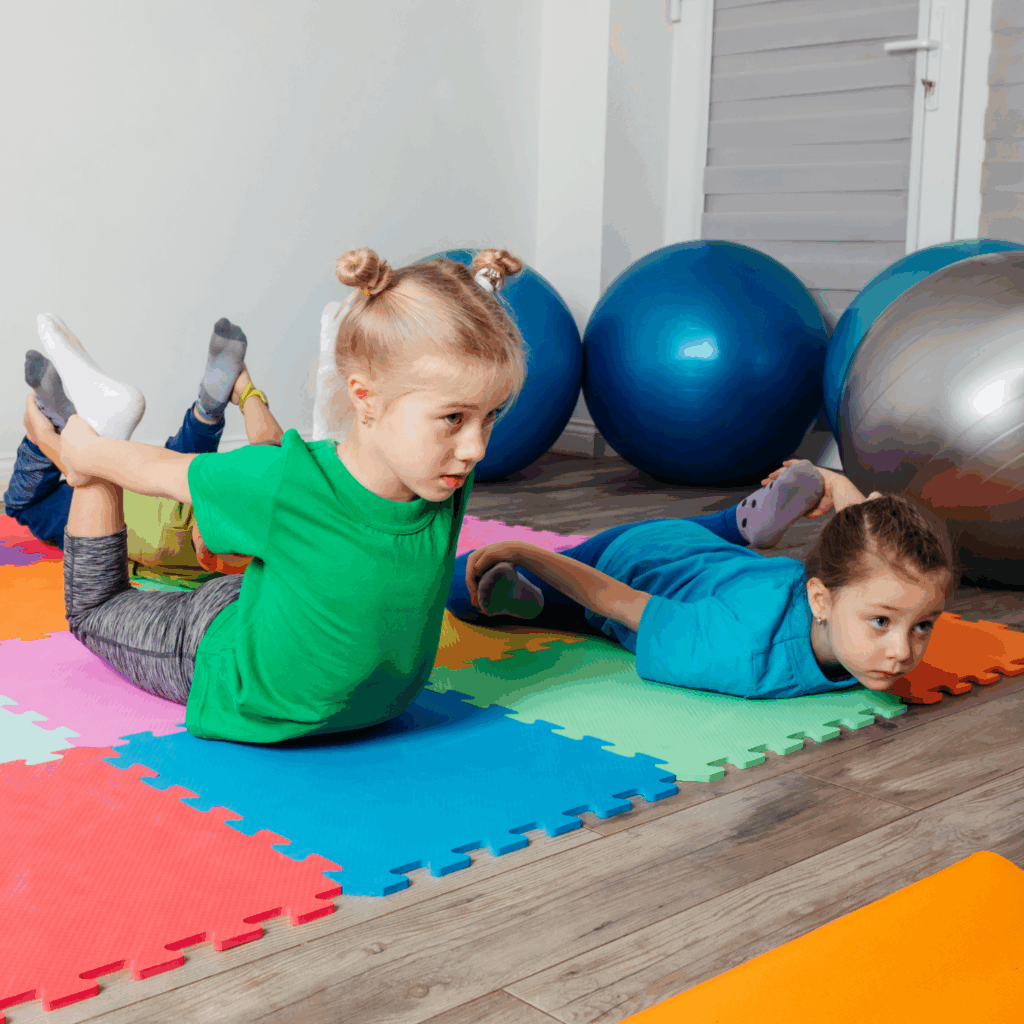
A growing body of research indicates that school‑based and clinical yoga interventions can reduce anxiety symptoms in children and adolescents. Systematic reviews have found improvements in perceived stress, mood, self‑esteem, and emotional regulation, particularly when yoga is practiced consistently and taught by trained professionals (Hagen & Nayar, 2014; James‑Palmer et al., 2020).
While yoga is not a replacement for mental health care, it can function as a complementary, preventative practice that supports children’s coping capacity in daily life.
Yoga, Play, and the Concerns Raised in The Anxious Generation
One of the central themes in The Anxious Generation is the decline of free, embodied play and the rise of sedentary, screen‑based childhood experiences. Haidt argues that children’s nervous systems evolved in environments rich in movement, social feedback, and physical risk—conditions that help calibrate stress responses and build resilience over time.
Well‑designed kids yoga programs can help reintroduce some of these missing elements:
- Embodied exploration rather than passive consumption
- Relational attunement between teacher and child
- Opportunities for safe challenge, balance, and strength‑building
- Offline presence that supports attention and connection
Importantly, yoga does this without adding pressure to perform or excel. When taught through choice‑based language and imaginative play, yoga supports competence without competition—an essential distinction for anxious children.
Trauma‑Informed and Developmentally Appropriate Teaching Matters

The benefits of yoga for children are not automatic. Research and clinical experience both highlight that outcomes depend heavily on how yoga is taught. Trauma‑informed kids yoga for emotional regulation emphasizes:
- Predictability and clear structure
- Consent‑based language (no forced poses or touch)
- Respect for individual sensory needs
- Cultural humility and inclusivity
- Collaboration with parents, schools, and healthcare providers when appropriate
Teachers working with children—especially those experiencing anxiety or neurodivergence—require specialized training that integrates child development, nervous system science, and ethical teaching practices.
Preparing Yoga Teachers—and Caring Adults—to Support the Next Generation

As childhood anxiety continues to rise, yoga teachers are not the only ones being called to respond. Parents, classroom teachers, caregivers, therapists, aunties, grandparents, and community leaders are increasingly seeking practical, embodied tools to support the children in their lives.
Learning how to offer yoga to kids is not about becoming a perfect instructor or running formal classes. It is about understanding how children’s nervous systems work, how stress shows up in young bodies, and how simple, playful practices can support regulation, confidence, and connection in everyday moments.
Soma Yoga Institute’s Kids Yoga Teacher Training (beginning February 2026) is designed for both yoga professionals and caring adults who want to show up for children with greater skill, sensitivity, and confidence. The training offers:
- A science-informed understanding of child development, anxiety, and nervous system regulation
- Practical tools for sharing yoga through play, storytelling, and relationship-centered teaching
- Trauma-informed, consent-based approaches suitable for homes, classrooms, studios, and community spaces
- Adaptable practices for different ages, abilities, and emotional needs
- Ethical frameworks for working with children and families
Participants often include yoga teachers, school educators, parents, caregivers, and mental health professionals—united by a shared intention to support children’s well-being in a rapidly changing world.
👉 Whether you are a parent wanting calmer mornings, a teacher supporting a busy classroom, a grandparent building connection, or a yoga teacher expanding your scope of practice, this training offers skills that can support you in offering trauma informed yoga for kids.
👉 Join the February 2026 Kids Yoga Teacher Training
- Format: Online, accessible internationally
- Suitable for: Yoga teachers, educators, parents, caregivers, and child-focused professionals
- Focus: Anxiety-aware, trauma-informed, developmentally appropriate kids yoga
Learn more and enroll here: https://www.somayogainstitute.online/kids-yoga-teacher-training
Conclusion: Yoga as a Protective, Embodied Resource
In an era where children are navigating unprecedented levels of stimulation, comparison, and pressure, practices that restore connection to the body are not a luxury—they are foundational. Yoga, when grounded in science, play, and compassion, offers children a way to feel at home in themselves.
By supporting emotional awareness, and embodied confidence, trauma informed yoga for kids does not remove the challenges of modern childhood, but it can help children meet those challenges with greater steadiness, curiosity, and care.
References
Bitsko, R. H., et al. (2022). Mental health surveillance among children—United States, 2013–2019. CDC.
Hagen, I., & Nayar, U. S. (2014). Yoga for children and young people’s mental health and well‑being: Research review and reflections on the mental health potentials of yoga. Frontiers in Psychiatry, 5, 35.
Haidt, J. (2024). The anxious generation. Penguin Press.
James‑Palmer, A., et al. (2020). Yoga as an intervention for the reduction of anxiety in children and adolescents: A systematic review. Journal of Child and Family Studies, 29, 188–203.
Khalsa, S. S., et al. (2018). Interoception and mental health: A roadmap. Biological Psychiatry: Cognitive Neuroscience and Neuroimaging, 3(6), 501–513.
Porges, S. W. (2011). The polyvagal theory. Norton.
Siegel, D. J. (2020). The developing mind (3rd ed.). Guilford Press.
Twenge, J. M., et al. (2019). Age, period, and cohort trends in mood disorder indicators among U.S. adolescents. Journal of Abnormal Psychology, 128(3), 185–199.