Abstract
As yoga teaching and therapeutic movement evolve, practitioners increasingly encounter students who arrive dysregulated from chronic stress, trauma, and embodied vigilance. Somatic Yoga informed movement and nervous-system-informed yoga offer essential frameworks for meeting these students compassionately and effectively. This article explores the neurophysiological foundations of protective tension, interoception, polyvagal theory, and neurofascial research, and describes why yoga teachers must integrate somatic literacy to support safe, inclusive, and transformative practice environments.
When we are truly present in our yoga practice, the body becomes a doorway to consciousness. Yet many practitioners show up on their mats with physiological patterns shaped by vigilance—shallow breath, muscular bracing, fragmented attention, and a subtle sense that ease is unavailable.
Introduction
Emerging scientific models—including neuroscience, polyvagal theory, and somatic psychology—continue to affirm a simple but profound truth: dysregulation, not lack of discipline, is often the primary obstacle to embodied practice.
As somatic and therapeutic yoga advance, teachers are being called to bridge ancient wisdom with contemporary science. The integration of somatic movement does not replace yoga’s philosophical roots; rather, it deepens the skillful application of these teachings through nuance, sensitivity, and compassionate attunement.
This article explores how somatic movement and nervous system regulation enhance yoga practice and instruction, and why these tools are essential for today’s yoga teachers.
How Somatic Yoga Supports the Inner Architecture of Safety
Yoga views the body as an expression of consciousness; contemporary science adds that the state of the nervous system profoundly shapes perception, decision-making, emotional regulation, and the capacity for self-inquiry.
Interoception and Embodied Awareness in Somatic Yoga
Interoception—the ability to sense internal bodily states—is central to emotional wellbeing and mind–body integration. Research shows interoceptive awareness correlates with reduced anxiety, decreased chronic pain, and improved emotional regulation (Farb et al., 2013; Khalsa et al., 2018).
When interoception is disrupted, students may:
- move mechanically
- dissociate from sensation
- override cues of overwhelm
Yoga teachers observe these patterns frequently, especially in students experiencing burnout or chronic stress.
Polyvagal Theory and Cues of Safety
Polyvagal theory (Porges, 2011) expands understanding of the autonomic nervous system by describing how we shift between states of mobilization, disconnection, and social engagement based on perceived safety.
Somatic pacing, gentle movement, and invitational language can shift practitioners toward ventral vagal regulation—the physiological state associated with curiosity, connection, and learning.
Somatic movement becomes a dialogue with the nervous system, rather than an effort to impose change upon it.
The Neurofascial Lens: Why Stretching Alone Cannot Release Protective Tension but Somatic Yoga Can
Traditionally, muscular tightness was viewed as a mechanical issue—something to be stretched or mobilized. However, fascia research has reframed this understanding. Pioneers such as Schleip, Stecco, and Myers show that tension patterns are neurofascial, shaped as much by autonomic input as by biomechanics.
Fascia Responds to the Nervous System, Not Willpower
Schleip (2003) demonstrated that fascia contains myofibroblasts, specialized contractile cells responding not to voluntary control but to sympathetic activation. This means patterns of:
- chronic stress
- trauma history
- emotional guarding
- persistent vigilance
- habitual bracing
can all cue fascia to stiffen—regardless of a practitioner’s intention to stretch or relax.
Fascia contracts to protect, not to defy flexibility training.
Why Traditional Stretching Often Fails
If the nervous system has not received cues of safety, stretching may provoke:
- rebound tightening
- shallow breath
- emotional flooding
- dissociation
- frustration
Yoga teachers routinely observe:
- hamstrings unchanged by years of stretching
- collapse (not relaxation) in forward folds
- shoulder tension even in restorative poses
- heightened anxiety after long-held stretches
These are not failures of technique—they are expressions of neurophysiology.
Somatic Movement as a Therapeutic Companion to Yoga
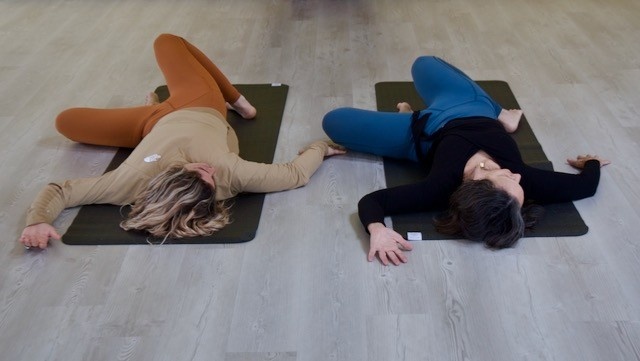
Somatic movement aligns with yogic principles of svādhyāya (self-study), ahimsa (non-harm), and viveka (discernment). It is not separate from yoga; it is yoga practiced with deeper attunement.
Key elements include:
- Pacing that respects nervous system thresholds
- Agency-supportive language
- Micro-movements that repattern neuromuscular patterns
- Rest periods for autonomic integration
- Interoceptive cues that encourage inner listening
These elements empower practitioners by restoring a felt partnership with their own bodies.
Neuroplasticity and Embodied Change
Slow, mindful, novel movement enhances neuroplasticity in sensory and motor pathways (Dayan & Cohen, 2011). This aligns with yogic teachings on samskara: we reshape patterns through attentive, repeated experience.
The Teacher’s Nervous System Matters
Somatic teaching requires not only knowledge but self-awareness. Students unconsciously track a teacher’s tone, pacing, and breath. A dysregulated teacher may inadvertently limit a student’s capacity to downshift.
This echoes Yoga Sutra II.46: sthira sukham āsanam—a steady and easeful presence as the ground of practice.
Working somatically invites teachers to:
- notice their own activation patterns
- cultivate internal spaciousness
- allow silence
- trust each student’s pacing
Presence becomes as important as technique.
A Path Forward for Yoga Teachers: Why Somatic Yoga Training Matters Now
Somatic movement and nervous system regulation do not replace yoga’s tools—they refine them. They allow asana, breathwork, and meditation to fulfill their purpose: to reconnect us with embodied wisdom.
For yoga teachers, somatic literacy is increasingly essential. Students now arrive carrying:
- chronic tension
- stress and burnout
- freeze/collapse patterns
- trauma histories
- nervous system fragility
Without understanding nervous system states, teachers may unintentionally reinforce overwhelm or perpetuate patterns the body cannot meet.
Somatic training equips teachers to:
- use trauma-aware pacing
- offer interoceptive cueing
- sequence to support vagal regulation
- soften protective holding
- craft language that fosters agency and safety
This work restores yoga to its therapeutic depth: relational, attentive, human.
As more teachers build somatic competence, yoga becomes not only a discipline of alignment but a pathway to nervous system healing.
Further Learning Opportunities
**Somatic Yoga & Nervous System Regulation
with Alison Scola, C-IAYT, E-RYT 500, LMT**
For yoga teachers and practitioners seeking to integrate somatic movement and nervous system science into their teaching, Alison Scola’s training offers a rigorous, compassionate, research-informed approach. Learn More Here.
Format:
• Four Saturdays: January 3, 10, 17, 24 (2026)
• 9:00 AM–12:00 PM PST on Zoom
• 12 CE hours (Yoga Alliance)
• Replays + handouts included
Participants will learn:
- trauma-aware somatic sequencing
- interoceptive and vagus-nerve-informed cueing
- micro-movement strategies for neurofascial release
- tools to support student safety and resilience
- how to regulate their own system while teaching
Fee: $277 ($227 Early Bird through December 20, 2025)
A free introductory class, “The Healing Power of Yoga,” is available for those wishing to experience Alison’s approach firsthand.
References
Dayan, E., & Cohen, L. G. (2011). Neuroplasticity subserving motor skill learning. Neuron, 72(3), 443–454. https://doi.org/10.1016/j.neuron.2011.10.008
Farb, N. A. S., Segal, Z. V., & Anderson, A. K. (2013). Mindfulness meditation training alters cortical representations of interoceptive attention. Social Cognitive and Affective Neuroscience, 8(1), 15–26. https://doi.org/10.1093/scan/nss066
Khalsa, S. S., Adolphs, R., Cameron, O. G., Critchley, H. D., Davenport, P. W., Feinstein, J. S., Feusner, J. D., Garfinkel, S. N., Lane, R. D., Mehling, W. E., Meuret, A. E., Paulus, M. P., & Zucker, N. (2018). Interoception and mental health: A roadmap. Biological Psychiatry: Cognitive Neuroscience and Neuroimaging, 3(6), 501–513. https://doi.org/10.1016/j.bpsc.2017.12.004
Porges, S. W. (2011). The polyvagal theory: Neurophysiological foundations of emotions, attachment, communication, and self-regulation. W. W. Norton & Company.
Schleip, R. (2003). Fascial plasticity – a new neurobiological explanation: Part 1. Journal of Bodywork and Movement Therapies, 7(1), 11–19. https://doi.org/10.1016/S1360-8592(02)00067-0